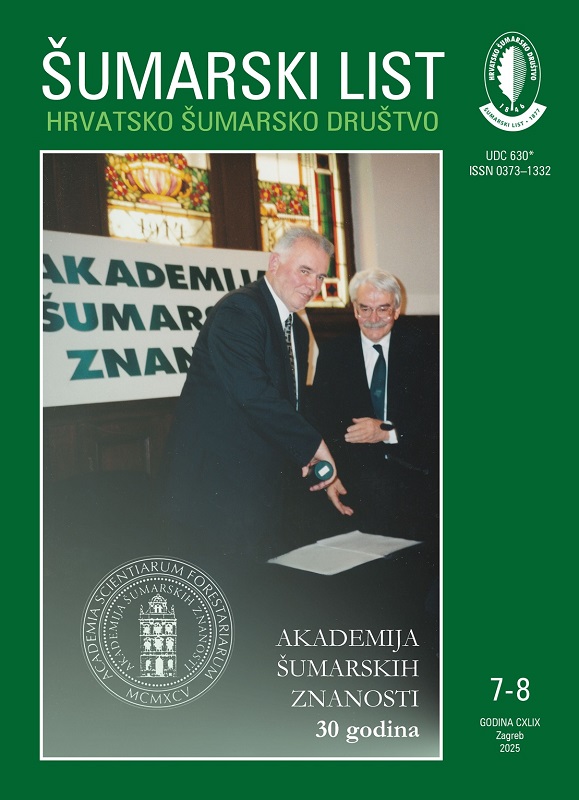
broj: 7-8/2025
pdf (4,96 MB) |
|
||||||||||||||


| RIJEČ UREDNIŠTVA | ||
| Uredništvo HŠD | ||
| Forest office – basic organizational unit of forestry pdf HR EN | 317 | |
| This year, Croatian forestry marks the 260th anniversary of the establishment of the first forest offices. It is widely known that these were the forest offices of Oštarije, Krasno, and Petrova Gora. To this day, only Krasno Forest Office has continuously existed since its establishment. However, the remaining two forest offices did not disappear, but only changed their headquarters’ locations. Oštarije Forest Office moved down to the coast in Karlobag, while Petrova Gora Forest Office moved out of the forest to the town of Vojnić, although half of the forests of Petrova Gora are managed by the forest offices of Gvozd and Topusko, so it can be said that they are also successors to one of the first three forest offices. The first forest offices were established as part of the military structure of the Croatian Military Frontier, which lasted for the next hundred years. These forest offices were transitioned into the civil system with the demilitarization of the Military Frontier in the early 1870s. In the civilian part of Croatia, forest offices were mostly established by large forest landowners, and to a lesser extent by the state, which did not possess large forest complexes in that area, and later by some municipalities for their own forests. It is worth recalling what forest offices as basic organizational units of forestry represent. By examining the preserved forestry maps from the 18th and 19th century, it is evident that the headquarters of forest offices were chosen in the heart of forest complexes. After the construction of the railway network, it became an important factor in choosing the headquarters of a forest office. The organization of forest offices for state forests was created in the 1870s in the territory of the Kingdom of Croatia-Slavonia, excluding Istria and Dalmatia. It comprised 43 forest offices with an average area of 15,000 hectares. The initial organization was further developed by establishing forest offices for municipal forests, which were separated from state forests. Thus, in 1923, the number of forest offices had grown to 79, with some locations having two forest offices – one for state forests and another for municipal forests. The average area of the forest office decreased to 9,000 hectares. At the beginning of 1942, after the dissolution of municipal forests and their return to state ownership, the number of forest offices increased to 102, with part of Dalmatia also being included in the forest area. The trend of growth continued after World War II with an increase in the area of state forests, and in 1952, within nine forest management units located from Ilok to Dubrovnik, the number of forest offices rose to 138. The maximum number of 187 forest offices within the territory of Croatian today’s borders was reached in 1955, when forest offices operated as institutions with independent financing, without forest management units. With the re-establishment of forest management units in the early 1960s, the number of forest offices stabilized, since there were no longer frequent reorganizations like in the previous 15 years. In most cases, practice showed that frequent changes did not bring any improvement, so former solutions were reinstated. With the establishment of Croatian Forests, a unified company for the management of forests and forest land in the Republic of Croatia, the number of forest offices in 1991 was 167. Today, the number is slightly higher, with 169 existing forest offices and an average forest office area of 12,000 hectares. Excluding 26 forest offices from Istria and Dalmatia, the average area per forest office is slightly less than 10,000 hectares. This is 5,000 hectares less than the average size of a forest office in 1873. The working conditions and tasks of a forest office over the past century and a half have changed significantly. In its early days, the main role of the forest office was to protect forests from illegal and unplanned logging, which is why most of the staff were forest guards. Over time, the role of the forest office evolved, and the need grew for educated forestry employees capable of performing all forest-related tasks. Thus, the forest office has always had a significant social role in the local community. Nowadays, when we observe negative demographic trends in Croatia, reducing the number of forest offices would only support the negative trend in rural areas. Closing forest offices in smaller communities would further reduce the motivation to live in those places, where even post offices, schools, and shops are disappearing. Although the days are gone when the most respected people in the village were the teacher, the priest, and the forester, the role of the forester in smaller communities is still significant. Today, foresters are among the few citizens of Croatia whose work covers all areas of the country, including border regions, which strengthens their role in overseeing the territory, especially with the construction of forest roads and firebreaks. In the territorial organization of the state, forest offices play an important role in the forestry sector, which is why the abolition of, for example, Čakovec Forest Office, the only forest office in Međimurje County, would reduce forestry in that county to the level of a district manager, which lacks the institutional strength and cannot represent either the profession or the forestry sector as a forest office manager can. Regardless of changes of states, social systems, types of forest ownership, and the organization of forestry, forest offices have always been and will remain the basic units responsible for performing operational tasks in the field. The stability of their existence guarantees greater dedication to the primary role of forestry in sustainable forest management. For all these reasons, let us preserve forest offices. They are proof of our presence in all parts of our homeland. Editorial Board | ||
| IZVORNI ZNANSTVENI ČLANCI | ||
| Krunoslav Sever, Filip Milaković, Antonia Vukmirović | UDKps://doi.org/10.31298/sl.149.7-8.1 | |
| Impact of drought on photosynthetic pigments in leaves of common beech and sessile oak, as well as on return calibration of chlorophyll meter MC-100 pdf HR EN | 319 | |
| Matej Knezičić, Toni Spitz, Ivan Juraj Čehulić, Karlo Bukal, Kristijan Tomljanović | UDKps://doi.org/10.31298/sl.149.7-8.2 | |
| Ornithofauna in the first age class of the pedunculate oak forest in Central Posavina pdf HR EN | 331 | |
| Marina Škunca, Sanela Damjanović, Oleg Antonić | UDKps://doi.org/10.31298/sl.149.7-8.3 | |
| Presence of invasive alien vascular plant species in the selected Natura 2000 sites in Croatia pdf HR EN | 341 | |
| Antonio Vidaković, Marijan Vuković, Ana Vuković, Matija Magdić, Valentina Gašparović, Igor Poljak | UDKps://doi.org/10.31298/sl.149.7-8.4 | |
| Evaluation of fruit and leaf morphological variability in bearberry (Arctostaphylos uva-ursi (L.) Spreng.) Dinaric Alps populations pdf HR EN | 353 | |
| Dejan B. Stojanović, Tom Levanič, Srđan Stojić, Bratislav Matović, Lazar Pavlović, Vladimir Višicki, Bojan Tubić, Marko Marinković, Saša Orlović | UDKps://doi.org/10.31298/sl.149.7-8.5 | |
| Combining satellite time-series and tree growth data of Pedunculate oak, Turkey oak, European beech and Scots pine pdf HR EN | 365 | |
| PREGLEDNI ČLANCI | ||
| Ivan Martinić, Anđela Antičević, Lara Zgrablić | UDKps://doi.org/10.31298/sl.149.7-8.6 | |
| The forest pedagogy programs in Croatia – evaluation approach and findings pdf HR EN | 375 | |