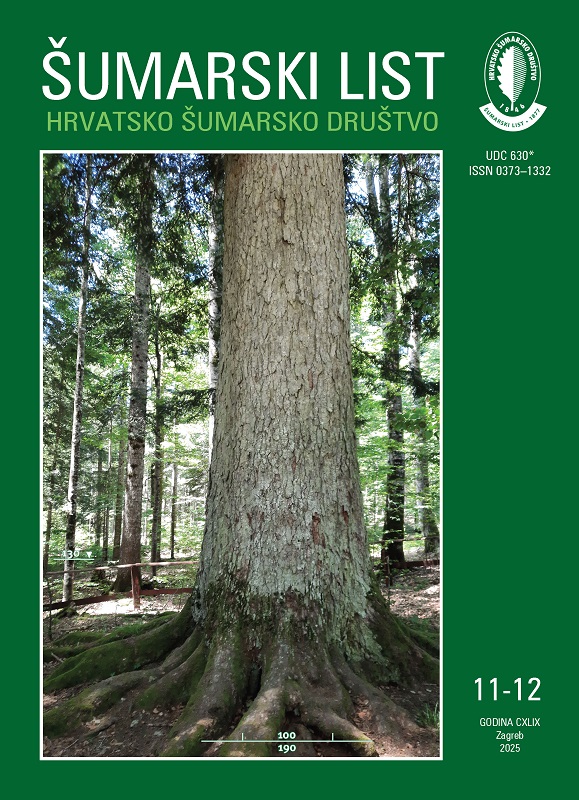
broj: 11-12/2025
pdf (8,07 MB) |
|
||||||||||||||



| RIJEČ UREDNIŠTVA | ||
| Uredništvo HŠD | ||
| At the end of 2025 pdf HR EN | 501 | |
| It was logical in 2025 to begin Forestry Journal issue 1–2/2025 with an editorial and cover on the 260th anniversary of Croatian forestry and a reminder of 23 February 1765, the birthday of Croatian forestry. However, we did not expect that the commemoration of such a significant anniversary would turn out to be rather modest throughout the year, especially compared to the celebration of 250 years of Croatian forestry, when the year 2015 was filled with numerous major and minor ceremonial and work activities. Unfortunately, several events in which individuals from the forestry sector violated the law, or in which forestry was used as a battleground for political disputes, did not provide a good foundation for devoting greater recognition to the previous generations of foresters who shaped our distinguished past.
The editorial of Forestry Journal issue 3–4/2025 was dedicated to the shocking amendment to the Regulation on determining compensation for forests and forest land issued by the competent ministry. It reduced the compensation by 99% in cases of donating property to local and regional self-government units and to state administration bodies for the purpose of exclusion from the forest management area of the Republic of Croatia. The entire compensation—consisting of the parts for the forest (timber stock), forest land, and the reduction of forest ecosystem services—was reduced to only 1% of the total amount. Once again, it became evident that each amendment to the legal and subordinate acts in the forestry sector further devalues forests and forestry. With a reminder that over the past 15 years the editorial had addressed the same topic—the (in)efficient use of state resources—no fewer than 16 times, we revisited this topic in the editorial of Forestry Journal issue 5–6/2025. This was prompted by the media coverage about Croatia exporting more timber than furniture. Unfortunately, so many reflections on this topic prove only that there has been no improvement. Even people outside the profession most likely know that forest offices are the basic organizational units of forestry. However, negative past experiences, in which reorganizations and the abolition of forest offices were approached too lightly, led us to address this topic in Forestry Journal issue 7–8/2025. The editorial of Forestry Journal issue 9–10/2025 accentuated that there can be no progress in forestry without science and without culture—an idea expressed by academician Dušan Klepac in his Ten Sentences on Forests written in 2004. The point of the editorial was to highlight the reduction in investment in forestry science. The lack of such investment will negatively affect the state of forests and forestry in Croatia. A profession with such a long tradition and with numerous institutions fulfilling their roles—from educating professionals, scientific research, operational forestry to professional associations—takes pride in many anniversaries. It is therefore worth recalling those we commemorated in 2025: 165 years since the founding of the Royal Agriculture and Forestry College in Križevci, 130 years since the founding of the Institute for Adriatic Crops and Karst Reclamation in Split, 80 years since the founding of the Croatian Forest Research Institute in Jastrebarsko, 65 years of the independent Faculty of Forestry, 35 years of Croatian Forests Ltd., and 30 years since the founding of the Academy of Forestry Sciences. In 2026 we can announce the following anniversaries: 180 years since the founding of the Croatian Forestry Society, the third oldest forestry society in Europe, and 150 years of uninterrupted publication of its scientific, professional, and guild journal—Forestry Journal. It should also be noted that the upcoming year will mark 20 years of the Croatian Chamber of Forestry and Wood Technology Engineers. We wish all members of the Croatian Forestry Society and all readers of our journal a Merry Christmas and a successful New Year 2026. Editorial Board | ||
| IZVORNI ZNANSTVENI ČLANCI | ||
| Ante Seletković, Albert Seitz, Andro Kokeza, Matej Matošević, Ivan Balenović | UDKps://doi.org/10.31298/sl.149.11-12.1 | |
| Accuracy of tree attribute estimates by personal laser scanning in an old pedunculate oak forest pdf HR EN | 503 | |
| Igor Poljak, Gabrijela Svalina, Nives Vulama, Mia Radočaj, Kristina Buzina, Daniel Krstonošić | UDKps://doi.org/10.31298/sl.149.11-12.2 | |
| Morphological and anatomical diversity of Juniperus sabina var. balkanensis in the Croatian Dinaric Mountains pdf HR EN | 517 | |
| Milan Mataruga, Branislav Cvjetković, Borut Bosančić | UDKps://doi.org/10.31298/sl.149.11-12.3 | |
| Cone and seed variability in Serbian spruce – indicators of population endangerment pdf HR EN | 531 | |
| Ibrahim Turna, Fahrettin Atar, Ali Osman Güzel, Fikret Koç, Giyasettin Akbin, Halil Bariş Özel | UDKps://doi.org/10.31298/sl.149.11-12.4 | |
| Assessment of growth parameters in Pinus sylvestris L. stands: Five-year results of precommercial thinning pdf HR EN | 545 | |
| KRATKA PRIOPĆENJA | ||
| Marta Kovač | UDKps://doi.org/10.31298/sl.149.11-12.5 | |
| A new tritrophic association: Syspastospora parasitica on Beauveria pseudobassiana infecting Corythucha arcuata pdf HR EN | 559 | |
| PREGLEDNI ČLANCI | ||
| Maja Cvek, Marko Vucelja, Darja Puškadija, Danijela Poljuha, Dalibor Broznić, Emina Pustijanac, Marina Šantić, Dijana Tomić Linšak | UDKps://doi.org/10.31298/sl.149.11-12.6 | |
| Ticks as vectors of zoonotic pathogens: public health aspects in the Istria county pdf HR EN | 563 | |